
RNA-seq analysis you can defend in review.
Publication-ready differential expression reports for research labs. Careful QC before any biology, honest statistics, and figures ready for your manuscript, in 5 to 7 business days.
Services
Fixed prices, fixed scope, no hourly billing. You send a count matrix and a sample sheet; you receive a report you can use.
| Service | What's included | Turnaround | Price |
|---|---|---|---|
| DE Report | One comparison, up to 24 samples. Full QC, DESeq2 differential expression, pathway enrichment, publication-ready figures, results tables and a written interpretation. One revision round. | 5 to 7 business days | $750 |
| Analysis Desk | Standing analysis support for labs that sequence regularly. Up to two DE Reports a month, priority turnaround and a monthly call. Three-month minimum. | 3 to 5 business days | $1,200 per month |
Additional comparisons are $200 each. Prices in USD.
Founding labs: the first five DE Reports are $450, in exchange for a short testimonial. Not sure yet? If your data is already public on GEO with raw counts, I can reanalyze one comparison free so you can judge the work first.
How a project works
Send your data
A count matrix and a sample sheet, plus the comparison you care about. Shared however suits you.
Design and QC check
Before any statistics, I confirm the design, look for batch effects, outliers and sample problems, and flag anything that needs a decision.
Analysis and report
Differential expression, enrichment and interpretation, written for a PI rather than a programmer.
Review together
You read the report and ask questions. One revision round is included.
See the full sample report
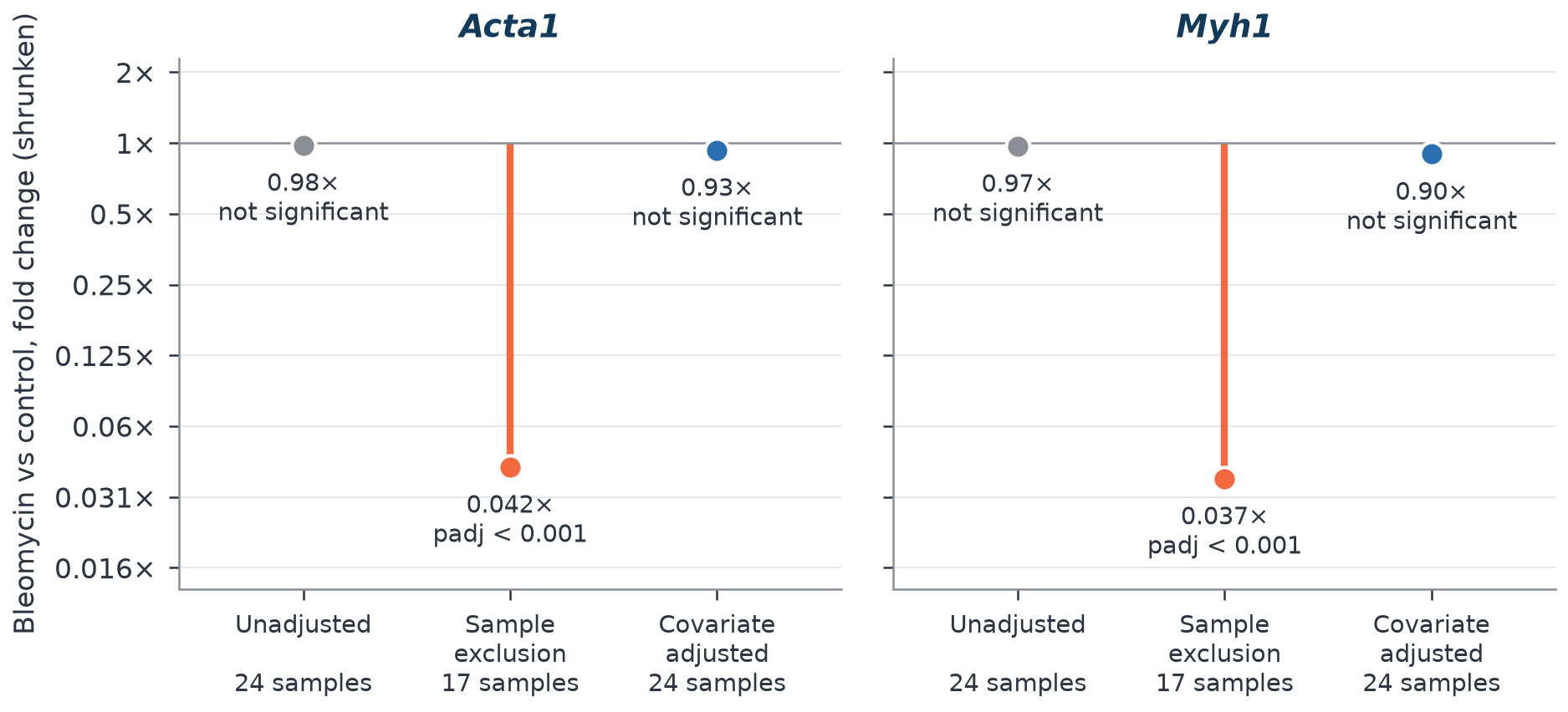
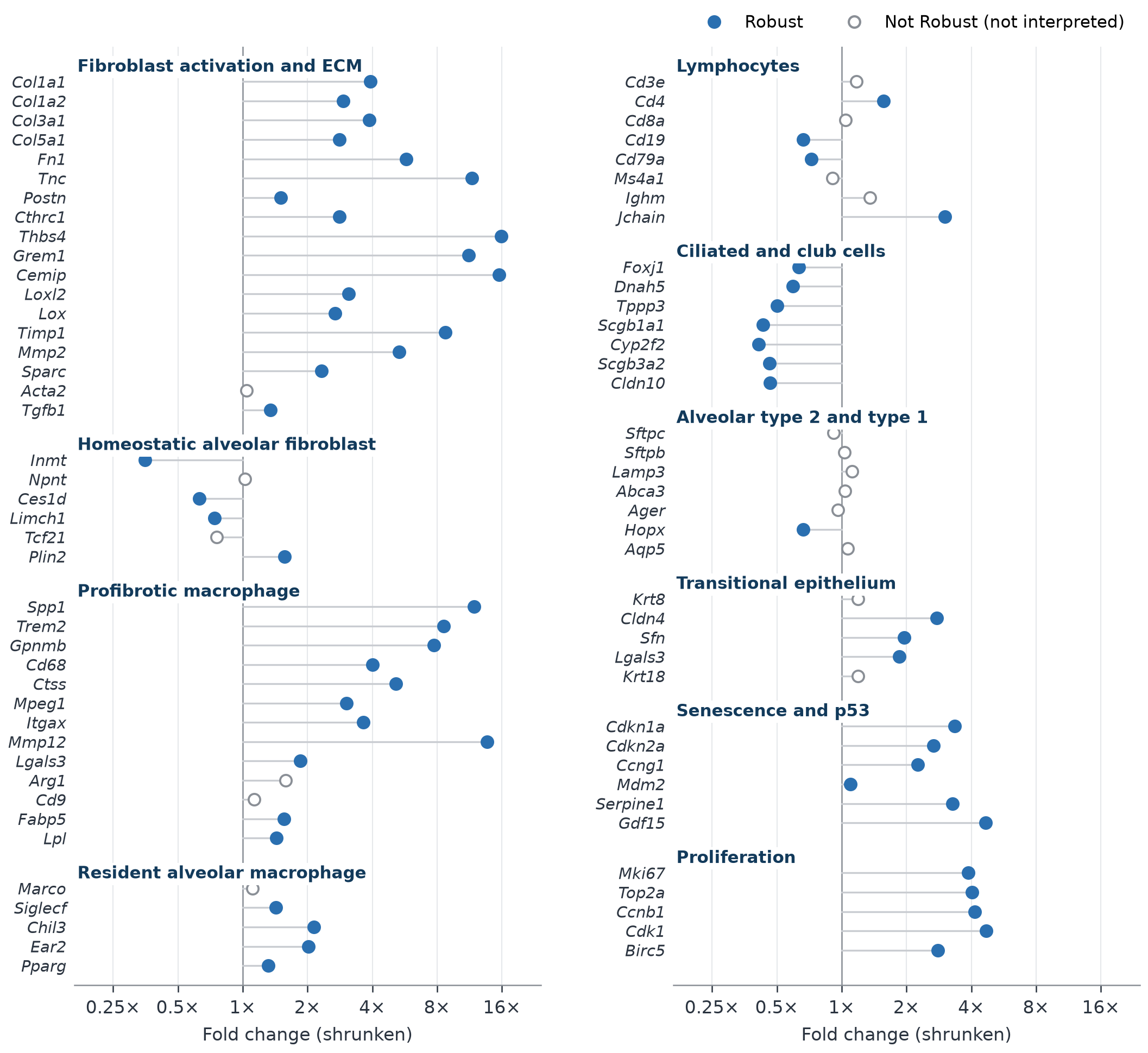
Every project follows the same standard as this worked example: a reanalysis of a published bleomycin lung fibrosis study (GSE301216, 10 controls vs 14 treated mice).
- An executive summary a PI can read in five minutes
- QC that explains what was found and how it was handled
- Results classified by how well they hold up, not just by p-value
- Biological interpretation that checks enrichment labels against the actual genes
- Methods and versions detailed enough for a reviewer
- Full results tables and figures as separate files
About
I'm Samkit Shah, founder of Phylomic. I trained in genetics at the University of Manitoba and focus on one thing: turning bulk RNA-seq data into analysis a lab can trust and publish.
Many labs don't have a dedicated bioinformatician, or would rather their students spent time on experiments than on debugging analysis code. That's the gap Phylomic fills.
What you can count on
- Reproducible analysis: pinned software versions and code you can rerun
- Plain statements of uncertainty, never overclaimed results
- Your data kept confidential, with an NDA available before you share anything
- A person who answers your questions about the analysis
Data security and confidentiality
Before any data is shared. A mutual NDA is available on request and can be signed before you send anything. Every project also runs under a written service agreement with confidentiality terms. If your institution requires its own data use agreement or a vendor security questionnaire, I'll complete it.
Transfer. Share data through your institution's own tools (Box, OneDrive, Google Drive, Globus, or your sequencing core's portal). Data is never requested as email attachments, and I will never ask for your account credentials.
What I accept. De-identified data only: count matrices and sample sheets. Please don't send protected health information or anything that identifies a human participant.
Storage and processing. Data is stored encrypted on a secured laptop and in Google Drive, and processed there and with a cloud analysis service used under confidentiality terms. A list of the services involved is available on request.
Retention and deletion. Your raw data is deleted within 30 days of final delivery, or sooner on request, with written confirmation if you want it. Deliverables are kept for 6 months so revisions stay possible, unless you ask for earlier deletion.
No reuse. Your data and results are never used for other projects, marketing or publications. Anything shown publicly as an example comes from public datasets, or from yours only with your written permission.
Questions
What data do I need to send?
A gene-level count matrix (raw counts, not normalized values) and a sample sheet describing each sample's group and any other relevant factors, such as batch or sex. If you're unsure what you have, send a description and I'll tell you.
What if my data has problems?
Then you'll hear about them before any results are reported, with a clear explanation and a recommendation. Finding problems early is part of the service, not an extra.
Can I use the figures and text in my paper?
Yes. The figures, tables and methods are yours to use in manuscripts, grants and presentations.
How do payment and invoicing work?
You receive an invoice in USD. Projects over $500 are billed 50% upfront, with the balance due within 14 days of delivery. The Analysis Desk is billed monthly in advance.
Do you work with labs outside the US?
Yes. Phylomic is based in India and works with labs internationally. Everything happens by email and shared files.
Tell me about your data
Send a short description of your experiment: organism, groups, number of samples and what you want to compare. You'll get a reply with what's possible, a price and a timeline.